Parkinson's Support in North County San Diego: Local Groups, Free Resources and Home Care
If you're caring for someone with Parkinson's in North County San Diego, start with the Parkinson's Association of San Diego (PASD). Its directory lists monthly support groups in La Costa (Carlsbad, 92009), Oceanside, Fallbrook near Bonsall (92003), and Rancho Bernardo, each open to people with Parkinson's and their care partners. The Association also offers free education for caregivers, a mentor program and practical tools for hospital visits.
Here's the local map, how a caregiving spouse can actually use it, and where in-home help fits once the day-to-day gets harder.
Where are Parkinson's support groups in North County San Diego?
The Association'ssupport group directorylists four in-person groups across North County. All four meet monthly and welcome both the person with Parkinson's and their care partner, so you can go together.
North County Parkinson's Support Groups (from PASD's directory)
- La Costa (Carlsbad): 1st Wednesday, 1 to 3 p.m., Christ Presbyterian Church La Costa, 7807 Centella St.
- Oceanside: 2nd Wednesday, 1 to 3 p.m., First Presbyterian Oceanside, 2001 S. El Camino Real at Fire Mountain Drive
- Fallbrook (near Bonsall): 4th Friday, 10 a.m. to noon, Fallbrook Regional Health & Wellness Center, 1636 E. Mission Rd.
- Rancho Bernardo: 1st Monday, 10 a.m. to noon, San Rafael Catholic Church, 17252 Bernardo Center Drive
- Care partners only: a virtual Parkinson's Care Partners group meets on Zoom on the 1st, 2nd and 3rd Tuesdays, 3 to 4:30 p.m.
- Meeting days, times and places change. Always confirm on the PASD directory before you go.
If you live in Vista or San Marcos, the Oceanside and La Costa groups are the closest on the list, and the virtual groups work from anywhere. The directory also lists Zoom groups for people with young onset Parkinson's, for people living with Parkinson's (without care partners in the room), a speaker series, and a caregivers-only group for atypical Parkinson's. Check the directory for anything closer to you.
What does the Parkinson's Association of San Diego offer families?
Beyond the groups, PASD runs several resources that are especially useful for the person doing most of the caregiving:
- Care Partner Education Program. A free, self-paced online course with 12 modules. Topics include caregiver self-care, fall prevention and home safety, sleep, driving, navigating hospital care, dementia, palliative and hospice care, downsizing and exercise.
- Mentor Program. Trained mentors who have "been there" listen, share their own experience and point you to resources. Care partners can request one, not just people with Parkinson's. Mentors don't give medical advice.
- Medical Safety Program. A free downloadable packet of forms to have ready for any hospital or care facility visit, including a medication list, contact lists and a physician letter you complete with your loved one's neurologist.
- Exercise directory. A list of exercise programs for people with Parkinson's, including several in North County, with a mix of paid, free virtual and donation-based options.
- PASD Journal. A complimentary bimonthly digital publication.
You can reach the Association at (619) 324-9788. Its office is at 4455 Murphy Canyon Road, Suite 100, in San Diego.
"In the journey with Parkinson's, care partners are, in many ways, the most critical players." That's how the Parkinson's Association of San Diego frames its care partner program, and it's worth taking seriously.
How can a caregiving spouse use these resources?
If you're the husband or wife doing most of the caregiving, here are a few ways to get real value out of what's already available:
Go to an in-person group together first. Because the North County groups welcome both of you, the first visit doesn't have to feel like you're "getting help." It's an afternoon out with people who understand.
Then find a room of your own. There are things you won't say with your spouse sitting next to you: the exhaustion, the grief, the 3 a.m. worry. The care-partners-only virtual group is built for exactly that.
Take the Care Partner modules in small pieces. Start with self-care and with fall prevention and home safety, since those two change the most about your day. Come back to the rest as questions come up.
Fill out the medical safety packet before you need it. It's far easier to complete at a calm neurology appointment than in an emergency room.
If you're already running on empty, our post oncaregiver burnout covers the signs worth taking seriously.
Where does in-home care fit as Parkinson's changes?
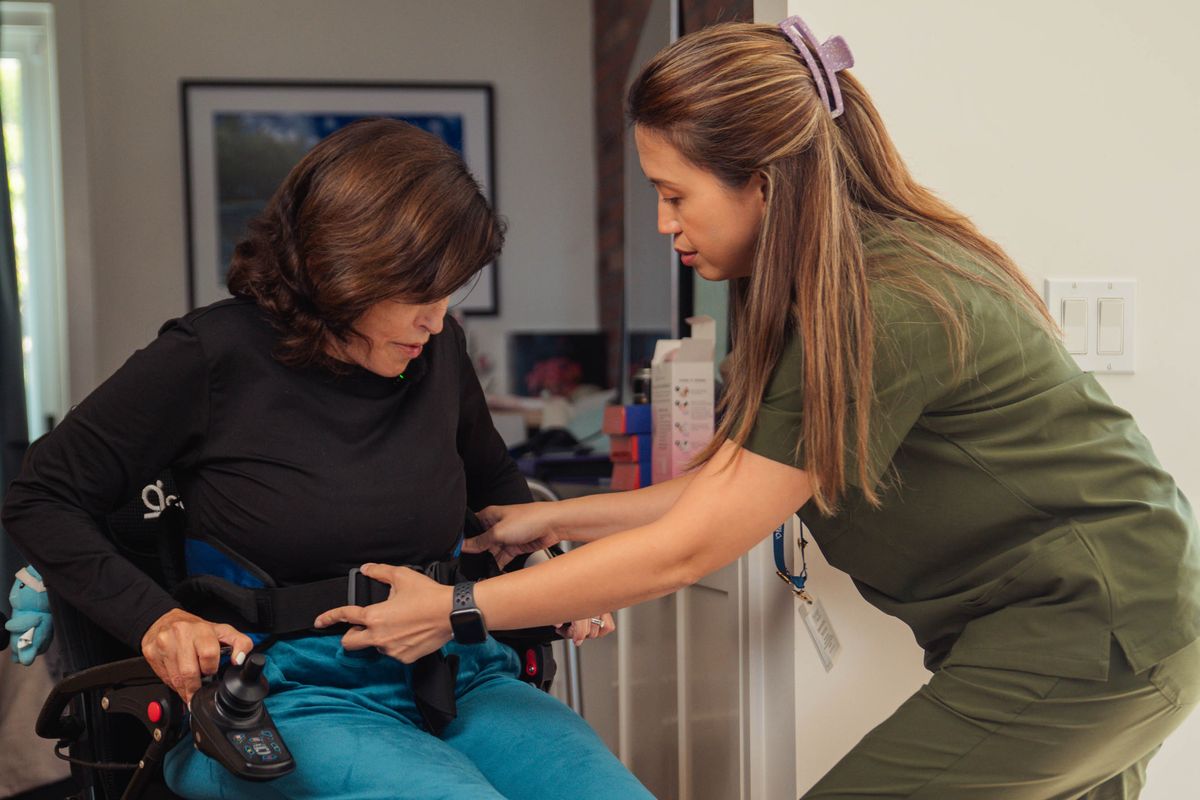
Support groups and education help you understand what's coming. They can't be in the house at 7 a.m. when your husband needs a steady arm getting out of bed, or on the afternoon you finally have a doctor's appointment of your own. That's the gap non-medical home care fills.
SYNERGY HomeCare of North County providesParkinson's care at home from our office in Carlsbad. It isn't medical care and doesn't treat the disease. What it does is take on the physical and daily parts of the day:
- Steadying help with transfers, walking and getting around the house
- Help with bathing and dressing, at a pace that doesn't rush
- Consistent daily routines around meals, getting ready and the day's activities
- Medication reminders throughout the day
- Rides to and from appointments, including neurology visits and exercise classes
- Regular respite care for the caregiving spouse, a few hours a week or more
As needs grow, care can scale up, including 24-hour care through a rotating team of caregivers in shifts. Our caregivers are background-checked, and we charge one hourly rate regardless of the type of care.
The honest limit: we don't provide therapy, medical treatment or medication administration. Those stay with your loved one's neurologist and medical team. Home care is there so the person with Parkinson's is safer at home and the spouse gets to stay a spouse, not just a caregiver.
If you'd like to talk through what help might look like for your family, a freeCare Consultation is a good place to start. Call us at (760) 990-4289.
Sources:PASD support group directory;Parkinson's Association of San Diego;Care Partner Education Program;PASD Mentor Program;Medical Safety Program;Exercise opportunities;PASD contact page.